
Mostrando entradas con la etiqueta orange. Mostrar todas las entradas
Mostrando entradas con la etiqueta orange. Mostrar todas las entradas
viernes, 15 de enero de 2010


jueves, 14 de enero de 2010
jueves, 10 de diciembre de 2009
miércoles, 4 de marzo de 2009
Ave del Paraiso / Bird of Paradise
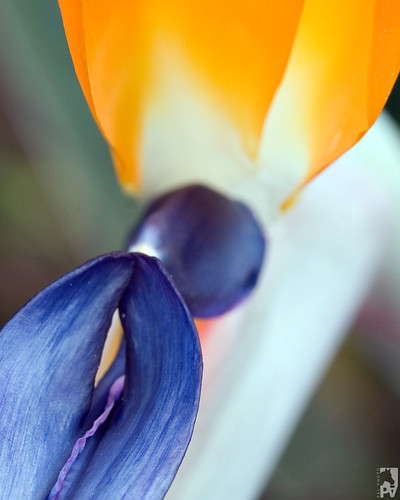
El ave del paraíso, de nombre científico (Strelitzia reginae), es una especie de angiosperma herbácea, rizomatosa originaria de Sudáfrica que se desarrolla cultivada en jardines en regiones tropicales y subtropicales. El término científico de esta planta reginae del Latín = "de la reina", está dedicado a la reina Carlota de Mecklenburgo-Strelitz, esposa del rey Jorge III de Inglaterra, muerta en 1818 y aficionada a la botánica. Planta herbácea semiverde, con forma de mata y hojas con largos pecíolos. Hojas alternas, pinnatinervadas y dísticas.
Su principal atractivo son las flores en forma de pájaro, con pétalos rojos y amarillos.
Las flores son hermafroditas, asimétricas, polinizadas por aves, en grupos cinciniformes protegidos primariamente por grandes brácteas varias laterales y con frecuencia largamente pedunculadas.
El perianto de 3+3 tépalos, los externos iguales y libres, los internos desiguales y generalmente soldados, uno de mayores dimensiones y plegado en forma de flecha rodeando al estilo. El gineceo de 3 carpelos soldados, ovario ínfero, trilocular, numerosos primordios seminales.
Fruto de cápsula valvicida por 3 valvas.
Altura promedio 15 dm y diámetro 18 dm.
_____________________________________________________________________________________
Strelitzia reginae is a monocotyledonous flowering plant indigenous to South Africa. Common names include Strelitzia, Crane Flower or Bird of Paradise, though these names are also collectively applied to other species in the genus Strelitzia. Its scientific name commemorates Charlotte of Mecklenburg-Strelitz, queen consort of King George III.
The plant grows to 2 m (6½ ft) tall, with large, strong leaves 25-70 cm (10-28 in) long and 10-30 cm (4-12 in) broad, produced on petioles up to 1 m (about 40 in) long. The leaves are evergreen and arranged in two ranks, making a fan-shaped crown. The flowers stand above the foliage at the tips of long stalks. The hard, beak-like sheath from which the flower emerges is termed the spathe. This is placed perpendicular to the stem, which gives it the appearance of a bird's head and beak; it makes a durable perch for holding the sunbirds which pollinate the flowers. The flowers, which emerge one at a time from the spathe, consist of three brilliant orange sepals and three purplish-blue petals. Two of the blue petals are joined together to form an arrow-like nectary. When the sunbirds sit to drink the nectar, the petals open to cover their feet in pollen.
martes, 17 de febrero de 2009
lunes, 16 de febrero de 2009
Clivia spp
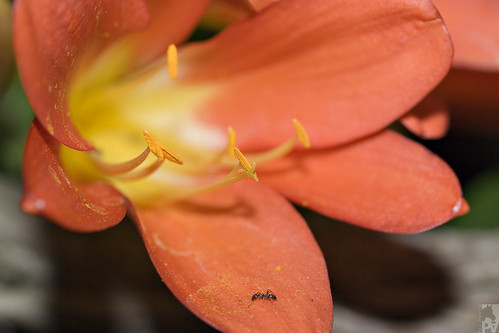
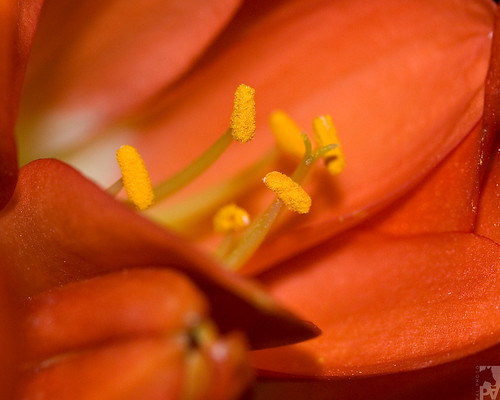
Clivia es un género de monocotiledóneas oriundas de África meridional. Son perennes no leñosas, con hojas de color verde oscuro, largas y estrechas que producen racimos de flores acampanadas rojas o anaranjadas al final de un largo tallo, asemejándose a los lirios. De las 6 especies conocidas, Clivia miniata y sus variedades híbridas son las más ampliamente cultivadas, con flores que oscilan entre el rojo anaranjado oscuro al amarillo pálido.
Se cultivan particularmente en Bélgica, Francia y China. Son plantas acaules, imperfectamente bulbosas, provistas de gruesas raíces fasciculadas. Las hojas son lineal-oblongas, planas, coriáceas. Las flores son hermafroditas, actinomorfas o ligeramente zigomorfas. El perigonio está compuesto por 6 tépalos unidos en la base formando un corto tubo y los segmentos son extendidos o rectos. El androceo está formado por 6 estambres, insertos en la garganta del perigonio, los filamentos son filiformes y las anteras son oblongas, dorsifijas. El ovario es ínfero, trilocular, con los lóculos 3-5 ovulados. El estilo es filiforme y el estigma es tripartido. El fruto es una baya globosa. Las flores se disponen en umbelas plurifloras en la extremidad de un escapo central, plano, áfilo, algo más largo que las hojas.
_____________________________________________________________________________
Clivia is a genus of monocot flowering plants native to southern Africa. They are from the family Amaryllidaceae. Common names include Kaffir lily and bush lily.
They are herbaceous evergreen plants, with dark green, strap-like leaves. Flowers are bell-shaped flowers on a stalk above the foliage, and they are borne in whites through yellow to red colours.
Of the six known species, Clivia miniata is the most widely cultivated, and hybrid varieties with flowers ranging from deep red-orange to pale yellow have been bred by growers.
C. miniata, C. gardenii, C. robusta and C. caulescens seedlings flower after three to four years, while the yellow varieties may take longer. C. nobilis will flower after seven or eight years. It is reported that C. mirabilis also takes about 6 years to flower.
Specimens were gathered by British explorers William Burchell and John Bowie in 1815 and 1820, respectively. Clivia nobilis became the first named species when in 1828 the Kew botanist John Lindley named it in honor of Lady Charlotte Florentia Clive, Duchess of Northumberland (1787-1866), who was for a time the governess of the future Queen Victoria.
jueves, 14 de febrero de 2008
Suscribirse a:
Entradas (Atom)